Why Does My Child Trigger Me So Much? (and How to Stay Calm)
By Shenode Nair, breakthrough coach · · 9 min read
It's 8:15 in the morning. The school bus comes at 8:30. You've asked five times for shoes to go on. Your child is lying on the floor, whining about the wrong socks.
And something in you snaps. Your voice rises to a pitch you swore you'd never use. Maybe you hear your own mother's or father's words coming out of your mouth. Your child's face crumples, and the guilt hits before the bus does.
You love this little person more than anything. So why do they, of all people, push you over the edge so fast?
The calm you want to give your child starts with calming what was stirred up in you.
The short answer
Children trigger us because they reach places nobody else can. Their behaviour can echo moments from our own childhood, such as being ignored, controlled or not allowed to have feelings. Combine that with exhaustion and the pressure to be a "good parent", and a normal moment of whining or defiance can set off a survival reaction. The intensity usually belongs to your history and your tiredness, not to your child.
The most common parenting triggers
Every parent has their own set, but a few come up again and again:
Not listening: repeating yourself five times and being ignored.
Whining and crying: a sound that can feel physically unbearable.
Defiance and "no": feeling disrespected or challenged.
Mess and chaos: toys everywhere, food on the floor, noise.
Sibling fights: constant refereeing that never ends.
Public meltdowns: the shame of being watched and judged, especially by family.
Homework battles: fear about their future mixed with frustration in the present.
Notice which ones get you hardest. Your strongest triggers are clues to what most needs healing in you.
Why children press our deepest buttons
In one line
Your child is doing what children do. Your reaction is shaped by what happened to you when you did those same things.
They activate your own childhood memories
When your child cries, defies or makes a mess, your nervous system quietly searches for matching memories. If your own crying was met with "stop it or I'll give you something to cry about", or defiance led to punishment and shame, your body learned that these behaviours are dangerous. Now, as a parent, your child's behaviour can trigger the same alarm, and you respond the way you were responded to.
They do what you were never allowed to do
This one surprises many parents. A child who freely says "no", demands attention or expresses big emotions can stir up resentment in a parent who was never allowed to. Underneath the irritation is often a very young voice saying, "I didn't get to do that."
The pressure to be a "perfect" parent
When your child misbehaves in front of in-laws, at a family function or in the school WhatsApp group, it can feel like a public verdict on your parenting. That fear of judgement adds a layer of shame to an already stressful moment, and shame very easily turns into anger.
An empty tank
Broken sleep, work pressure, the mental load of running a home and very little time for yourself all shrink your window of tolerance. On a rested day you might laugh at the sock drama. On an exhausted one, it's the last straw.
"Your child is not giving you a hard time. Your child is having a hard time, and so, very often, are you."
What to do in the moment
Pause before you speak. Even three seconds helps. Put your hands on the counter, look away briefly, and let the first wave pass.
Breathe out slowly. A long exhale signals safety to your own nervous system. You can't help your child calm down while yours is on fire.
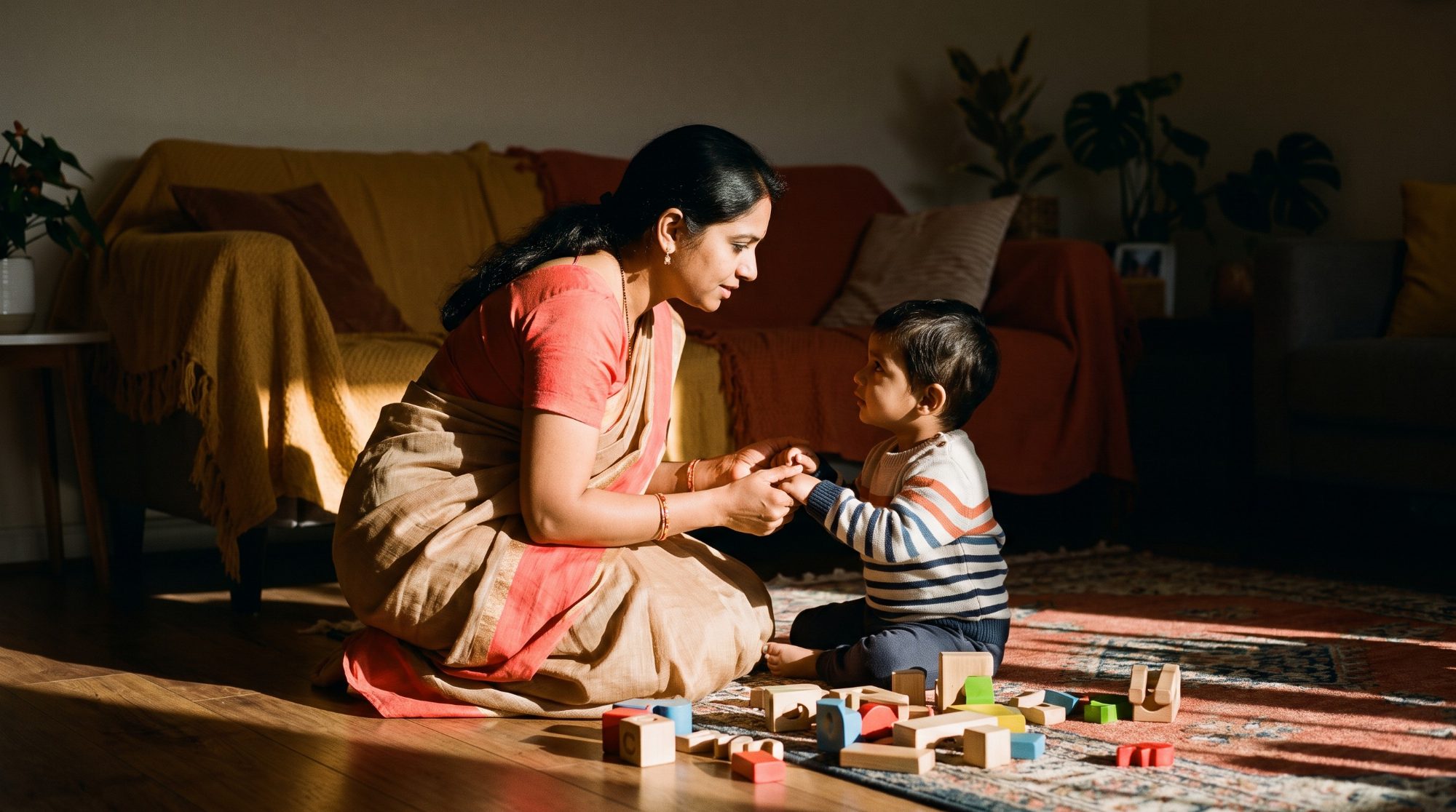
Get lower and softer. Kneel to their level, lower your voice. Your body's calm is contagious, just as your tension is.
Name what's happening. "You're really upset about the socks." Feeling understood often settles a child faster than any instruction.
Hold the limit kindly. "And we still need shoes on for the bus." Calm doesn't mean giving in; it means staying steady.
Step away if needed. If you're close to exploding, make sure your child is safe and take a minute: "Mumma/Papa needs a moment to calm down. I'll be right back."
Connection in calm moments makes the hard moments easier to repair.
The power of repair
You will lose your temper sometimes. Every parent does. What matters most is not whether ruptures happen, but whether repair follows. When you come back and say, "I'm sorry I shouted. I was feeling overwhelmed, and it wasn't your fault. I love you," you teach your child three powerful lessons: big feelings are survivable, mistakes can be mended, and they are still loved.
Many of us never received that kind of repair as children. Offering it to our own children is one of the most healing things we can do, for them and for ourselves.
Healing your side of the story
Tips and scripts help, but if certain behaviours reliably flip you from calm to furious, it's a sign that an old wound is involved. Parents often notice the shift when they work on their own past: the strict household, the comparison with cousins, the childhood where feelings had nowhere to go.
When that younger part of you is acknowledged and the stored emotion released, your child's behaviour stops landing on an old bruise. Approaches such as inner child healing, guided emotional release, EFT and, for some, hypnotherapy help make this shift at the level where the pattern lives. Many parents describe it as finally becoming the parent they always wanted to be.
Calm starts with you: Sukoon is two live evenings on Zoom, timed to fit around family life, where parents release the stress and old emotion they've been carrying, so there is more patience left for home.
Children's behaviour often touches emotions and memories from our own childhood, especially around being ignored, disrespected or out of control. Add tiredness and stress, and a normal moment of whining or defiance can feel like a threat. The intensity usually comes from your history and your exhaustion, not from your child.
Is it normal to feel triggered by my child?
Yes. Almost every parent feels triggered at times. Children are loud, messy and testing by design, and they expose our tiredest, most vulnerable places. What matters is noticing the pattern, repairing after hard moments, and getting support if anger feels frequent or frightening.
How do I calm down when my child is pushing my buttons?
Pause before responding, take a few slow breaths with a longer exhale, lower your voice and body, and remind yourself that your child is having a hard time, not giving you a hard time. If you need to, step away briefly while keeping your child safe, then come back to reconnect.
Will my shouting harm my child?
Occasional ruptures are part of family life. What protects children most is repair: calming down, apologising and reconnecting. Frequent, frightening anger is different and deserves support, for your sake and theirs.
An invitation for parents
Become the calm you want your child to feel
You can't pour from an empty cup, and you can't stay calm on top of years of unreleased stress. Sukoon gives you two evenings that are just for you: guided, gentle release of what you've been carrying, so you have more patience and warmth left for home.
Two live 90-minute evening sessions on Zoom, after the kids are settled
Guided emotional and body-based release, done gently and safely
Simple tools to pause before you react
Runs every month, for ₹99, with a free healing toolkit included
Shenode Nair is a breakthrough coach and hypnotherapist based in Pune. For more than a decade he has helped parents, professionals, founders and homemakers release emotional patterns that logic alone couldn't shift.
Before founding InnerWorkz he worked in corporate IT, including at Dell. He is a certified NLP Practitioner (ABNLP), EFT Level 3 Practitioner (AAMET) and Matrix Reimprinting practitioner, and works with clients in Pune and online across India.
This article is for general education and isn't a substitute for medical, psychological or child-development advice. If your anger feels frequent or frightening, or you're worried about your child's safety or wellbeing, please reach out to a doctor or licensed professional. Shenode Nair is a certified coach and practitioner, not a counsellor, psychologist or medical doctor. Read our full disclaimer.