What Is Emotional Baggage, and How Do You Actually Release It?
By Shenode Nair, breakthrough coach · · 10 min read
You've read the books. You understand your patterns. You've even forgiven people, at least in your head. And yet something still feels heavy.
A comment from a relative still stings years later. A smell or a song can drop you straight back into an old feeling. Your shoulders live somewhere near your ears. You wake up tired, and there's a background ache you can't quite name.
That weight has a name: emotional baggage. And the reason understanding alone hasn't lifted it is that baggage isn't stored only in your thoughts.
You were never meant to carry everything forever.
The short answer
Emotional baggage is unresolved emotion from the past, such as hurt, grief, guilt, fear or anger, that was never fully felt or expressed. Because it wasn't processed, it stays stored in the nervous system and body, and it quietly shapes how you react, relate and feel today. It's released not by thinking about it more, but by safely feeling and letting go of what was held, often with the body involved.
Signs you're carrying emotional baggage
Baggage rarely announces itself. It shows up sideways, in ways that are easy to blame on personality or circumstances:
Reactions that feel bigger than the situation, like snapping, crying or shutting down.
The same relationship or work patterns repeating, no matter how hard you try.
Chronic tension, tiredness or aches with no clear physical cause.
Difficulty relaxing, or a vague sense of dread when things are quiet.
Numbness: feeling flat or disconnected from joy.
Guilt or shame that switches on easily, often about things that aren't your fault.
Avoiding certain people, places or conversations because of how they make you feel.
If you recognise several of these, it doesn't mean you're damaged. It means you've lived through things and haven't yet had the chance to put them down.
How baggage gets stored
In one line
Emotions are meant to move through us. When they can't, because it wasn't safe, allowed or possible at the time, the body holds on to them.
Every emotion comes with a physical wave: tears with grief, heat with anger, trembling with fear. In ideal conditions that wave rises, peaks and passes. But many of us learned early to stop the wave halfway. Boys were told not to cry. Girls were told not to be angry. Children in busy or strict homes learned that feelings were inconvenient. Adults learned to "adjust" and keep going.
A swallowed emotion doesn't vanish. The nervous system keeps a record of it, and the body often holds it as muscle tension, shallow breathing or a constant low-level alertness. Over years, these unfinished waves stack up. That stack is what we call baggage.
"What we don't feel, we carry. What we carry, we eventually pass on, unless we set it down."
Where you might feel it in your body
Everyone is different, but many people notice held emotion in familiar places:
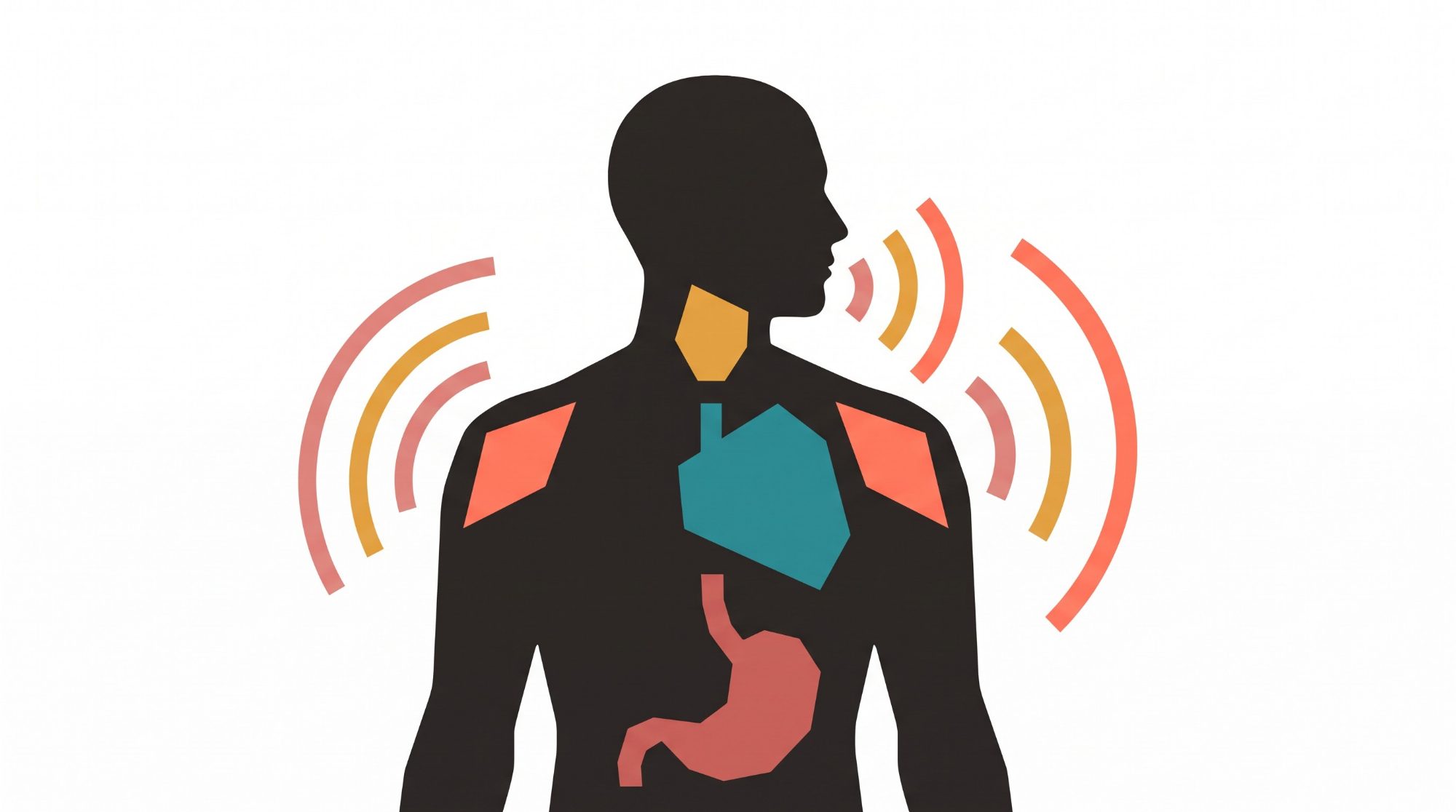
ThroatSwallowed words, unspoken truths, the lump that comes when you hold back tears.
ChestGrief, heartbreak and loneliness, often felt as heaviness or tightness.
Shoulders & neckResponsibility and stress, the weight of carrying everyone and everything.
StomachAnxiety and fear, felt as knots, churning or digestive trouble.
JawAnger held back, with clenching and grinding, often at night.
Whole bodyLong-term stress, felt as fatigue, numbness or a body that never fully relaxes.
Held emotion often shows up as tension in familiar places.
Why talking about it isn't always enough
Talking helps. Understanding helps. But many people reach a point where they can explain their story perfectly and still feel exactly the same. That's because insight works with the thinking brain, while baggage is held in the emotional brain and the body, which don't respond to reasoning in the same way.
It's a bit like knowing intellectually that a dog is friendly while your heart still races because you were bitten as a child. Knowing and feeling are different systems. Real release usually needs both: understanding and an experience in which the body gets to complete what it once couldn't.
How to release it, step by step
Create safety first. Old emotion only comes up when the body feels safe enough. Slow breathing, a quiet space and a supportive presence matter more than any technique.
Notice where it lives. Close your eyes and scan your body. Where is there tightness, heaviness or numbness? Simply noticing, without trying to fix it, often starts the shift.
Let the wave move. If tears, trembling, sighing or yawning come, let them. These are the body's natural ways of discharging stress. They're signs of release, not breakdown.
Give it words or movement. Write an unsent letter. Shake out your arms. Hum, sigh or stretch. Expression helps complete the emotional wave.
Meet the younger you. Much baggage was formed when you were young. Imagining the child you were and offering them the comfort they didn't receive can soften very old pain.
Rest and integrate. After release, many people feel lighter but tired. Drink water, rest and be gentle with yourself while your system settles.
Some of this you can do on your own. Older or heavier pain usually releases more easily with guidance, because a skilled, steady presence helps your nervous system feel safe enough to let go. Approaches such as guided emotional release, EFT tapping, inner child work, Matrix Reimprinting and, for some people, hypnotherapy are designed to do exactly this, gently and without needing to relive everything in detail.
Experience it, don't just read about it: Sukoon is a two-evening live experience on Zoom built around this process: guided, safe release of the emotional load you've been carrying.
Your body feels lighter, and long-held tension begins to ease.
Reactions soften; there's space between the trigger and your response.
Sleep often improves, and calm becomes more familiar.
Relationships feel less loaded with the past.
Energy returns for things that matter to you.
Common questions
What is emotional baggage?
Emotional baggage is unresolved emotion from past experiences, such as hurt, grief, guilt, fear or anger, that was never fully felt or processed. It stays stored in the body and mind and quietly shapes how we react, relate and feel in the present.
Where is emotional baggage stored in the body?
Many people feel held emotion as physical tension: a tight throat when words were swallowed, heaviness in the chest with grief, knots in the stomach with anxiety, or tight shoulders and jaw with stress and anger. Stress research shows that emotions and the body are closely linked, which is why body-based approaches help release them.
Can you release emotional baggage on your own?
You can start on your own with journaling, breathwork, movement and allowing feelings to be felt. Deeper or older pain often releases more easily with guided support, because a safe, structured space helps the nervous system let go of what it has been holding.
How do I know if I'm carrying emotional baggage?
Common signs include overreacting to small things, repeating the same relationship patterns, chronic tension or tiredness, difficulty relaxing, numbness, and feeling heavy for no clear reason. If the past keeps showing up in your present, there is likely something unprocessed underneath.
An invitation
Ready to set some of it down? Begin with Sukoon.
Sukoon Dil Ka is the experience we created for exactly this moment, when you know you're carrying too much and want to feel lighter, not just understand why. Over two live evenings, you'll be guided through gentle, body-based emotional release in a safe group space. You don't have to share your story or relive anything you don't want to.
Two live 90-minute evening sessions on Zoom
Guided emotional and body-based release, done gently and safely
Practices you can keep using at home
Runs every month, for ₹99, with a free healing toolkit included
Shenode Nair is a breakthrough coach and hypnotherapist based in Pune. His own path into this work began after witnessing a deep emotional release first-hand, and for more than a decade since he has helped people put down what logic alone couldn't shift.
Before founding InnerWorkz he worked in corporate IT, including at Dell. He is a certified NLP Practitioner (ABNLP), EFT Level 3 Practitioner (AAMET) and Matrix Reimprinting practitioner, and works with clients in Pune and online across India.
This article is for general education and isn't a substitute for medical or psychological care. If you're dealing with trauma, depression, or thoughts of harming yourself, please reach out to a doctor, licensed mental health professional or emergency services. Shenode Nair is a certified coach and practitioner, not a counsellor, psychologist or medical doctor. Read our full disclaimer.