How to Stay Calm at Work When Your Boss, Inbox and Deadlines Keep Triggering You
By Shenode Nair, breakthrough coach · · 9 min read
A "quick call?" message from your manager. Forty-seven unread emails before 9 am. A colleague presenting your idea as theirs. Your face goes hot, your stomach drops, and for the rest of the day you replay it while pretending to be fine.
Or you did react: a sharp reply, a door closed a little too hard. Now you're dreading Monday.
Workplaces are full of triggers, and in an always-on work culture, with calls at 10 pm and appraisals that feel like verdicts, there is very little room to recover. The goal isn't to stop feeling. It's to stay yourself while you feel.
A single deliberate breath can change the next ten minutes of your day.
The short answer
Staying calm at work doesn't mean hiding your feelings. It means catching the surge early, settling your body for about 60 seconds, buying yourself a little time, and then choosing your response. Most workplace triggers echo older experiences, such as being judged, ignored or controlled, so the same few situations hit hardest. Knowing your triggers, keeping a few ready-made sentences and repairing quickly when you slip are what build a steady presence over time.
Why work triggers us so intensely
On paper, an email is just text. In the body, it can feel like a threat, because work touches the things our nervous system cares about most: income, belonging, status and approval. A frown from someone who controls your appraisal lands very differently from a frown from a stranger.
Work also recreates early relationships. A manager with a sharp tone can feel uncomfortably like a strict teacher or a critical parent. A colleague who ignores you can feel like the child who was never picked for the team. Your adult mind knows the difference, but your body responds to the old pattern, quickly and strongly.
That is why the same few situations make you lose your footing again and again, while others shrug them off. It isn't weakness. It's history.
The four most common workplace triggers (and what's underneath)
1. Criticism or feedback
What it looks like: hot face, defensiveness, or a sinking feeling that makes you go silent. What's often underneath: "I'm not good enough." Feedback about the work gets heard as a verdict on you.
2. Pressure and unclear expectations
What it looks like: tight chest, irritability, snapping at colleagues, working late to avoid being caught short. Underneath: fear of failing, and an inner rule that you must be perfect to be safe.
3. Being ignored or overlooked
What it looks like: sulking, resentment, an urge to prove yourself or to withdraw. Underneath: "I don't matter," an old ache of being unseen.
4. Conflict with authority
What it looks like: freezing, over-explaining, or pushing back too hard. Underneath: an early fear of punishment or disapproval, which your body reacts to as if a parent or teacher were in the room.
Take a moment to ask: which of these is mine? Knowing your one or two strongest triggers is half the work, because what you can predict, you can prepare for.
A 60-second reset you can do at your desk
Nobody needs to notice you doing this. It works in a meeting, on a call, or in the corridor.
Feet and shoulders. Press your feet into the floor and let your shoulders drop. Unclench your jaw and soften your hands.
Three slow exhales. Breathe in gently through the nose, then out slowly, longer than the inhale. Three times is enough to start shifting the body.
Name it, silently. "This is the not-good-enough feeling." "This is pressure." Naming creates a little distance between you and the surge.
Buy a moment. Take a sip of water, glance at your notes, or use one of the sentences below.
Choose your reply. Ask: what would the calmest, most professional version of me say? Then say only that.
A settled presence in the room is more persuasive than a perfect argument.
What to say when you need time
The hardest part of a trigger is the pressure to respond instantly. You almost never have to. Keep a few sentences ready, so you don't need to invent them while your heart is racing:
"Thanks for flagging this. Let me think it through and come back to you by 4 pm."
"I want to give you a proper answer. Can I take five minutes?"
"I can see this is urgent. Could we agree on what comes first?"
"I'd like to come back to this once I've had time to think about it."
The email rule
If a message has set you off, write your reply in a draft and do not send it. Walk away for ten minutes, or sleep on it if it is late. Then read it aloud, and delete anything you wouldn't say in front of the whole team. Almost nobody regrets waiting.
If you slip: repair quickly
You will sometimes react anyway. What matters is the repair. A quick, grounded sentence can restore trust faster than a perfect performance ever could:
"I reacted more sharply than I meant to earlier. I'd like to reset and hear your point properly."
Repair makes you more credible, not less. Colleagues remember how you recover far longer than they remember the slip.
Build the muscle: a 3-minute end-of-day review
Before closing your laptop, ask yourself:
What triggered me today?
What did my body do (heat, tightness, going blank)?
What did I actually need (clarity, respect, rest, space)?
What will I try next time?
Within a few weeks, you'll see your own patterns, and the surprise starts to fade.
When it's a pattern
If you notice that the same kind of person, or the same kind of comment, always floors you, the trigger is probably older than the job. Releasing the original experience, through guided emotional release, EFT or inner-child work, is what changes it at the root, rather than re-managing the same reaction for years. Many high performers discover that this is also the missing piece in avoiding burnout. (See high-functioning burnout and why we people-please.)
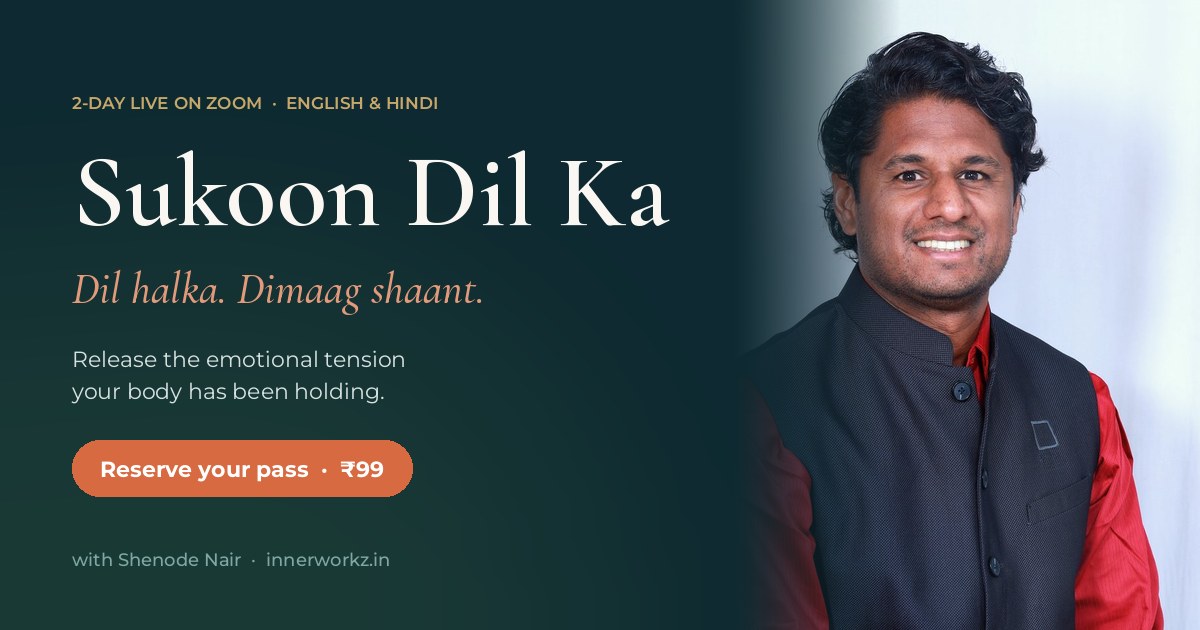
Bring calm back to your working life: Sukoon is two live evenings on Zoom where you are guided to release the stress and old emotion your body carries into work, and leave feeling lighter.
You respond to feedback and pressure with curiosity, not collapse or counter-attack.
You decide better, because you aren't deciding while flooded.
People start to trust your presence, which is the heart of leadership.
You take less of the day home with you, and recover faster on weekends.
You are less likely to burn out, because you stop absorbing every spike.
Common questions
How do I stay calm when my boss criticises me?
Slow your exhale, relax your shoulders and give yourself a moment before replying. A phrase such as "Thanks, let me take that in and come back to you" buys time. Afterwards, separate the useful feedback from the tone, and notice if the criticism touches an older feeling of not being good enough.
Is staying calm at work the same as hiding my emotions?
No. Hiding emotions is suppression and tends to leak out later as stress or outbursts. Staying calm means feeling the emotion, settling your body, and choosing when and how to express it in a way that fits the situation.
What should I do if I feel like crying at work?
Crying is a normal stress response, not a weakness. Excuse yourself if you can, breathe out slowly, splash cool water on your face and let the wave pass. If it happens often, it is a sign that your stress load or an old trigger needs attention.
How can I stay calm before an appraisal or presentation?
Practise a few rounds of longer exhales before you go in, press your feet into the floor, and remind yourself that nervous and excited feel similar in the body. Preparing a simple opening line also reduces the surge at the start.
An invitation
Bring calm back to your working life, with Sukoon
Sukoon means calm. In two live evenings, you are guided to release the stress, pressure and old emotional charge you carry into every meeting, so staying steady stops being something you have to force.
Two live 90-minute evening sessions on Zoom
Guided release of stored stress, done gently and safely
Practical tools to settle yourself before and after hard conversations
Runs every month, for ₹99, with a free healing toolkit included
Shenode Nair is a breakthrough coach and hypnotherapist based in Pune. For more than a decade he has helped professionals, founders, parents and homemakers release emotional patterns that logic alone couldn't shift.
Before founding InnerWorkz he spent years in corporate IT, including at Dell, so he knows life in survival mode from the inside. He is a certified NLP Practitioner (ABNLP), EFT Level 3 Practitioner (AAMET) and Matrix Reimprinting practitioner, and works with clients in Pune and online across India.
This article is for general education and isn't a substitute for medical or psychological care. Workplace stress, harassment or bullying may need HR, legal or professional support. If you feel unable to cope or have thoughts of harming yourself, please contact a doctor or qualified mental health professional. Shenode Nair is a certified coach and practitioner, not a counsellor, psychologist or medical doctor. Read our full disclaimer.