What Is Emotional Regulation, and Why Does It Matter So Much?
By Shenode Nair, breakthrough coach · · 9 min read
You snapped at someone you love and heard your own voice rise as if it belonged to a stranger. Or you did the opposite: smiled, said "it's fine", and carried a knot in your stomach for the rest of the evening.
Afterwards comes the question that so many of us quietly ask: why can't I just stay calm, like other people seem to?
Here is the good news. What you're missing isn't strength, maturity or character. It's a skill called emotional regulation, and like any skill, it can be learned.
Regulation isn't about feeling less. It's about staying yourself while you feel.
The short answer
Emotional regulation is the ability to notice what you feel, let the feeling be there without being swept away by it, and choose how you respond. It does not mean suppressing emotions or being calm all the time. It matters because unregulated emotions quietly shape your relationships, your decisions, your sleep and your health. And because it's a skill of the nervous system more than of willpower, it can be built at any age.
What emotional regulation is (and isn't)
Emotional regulation is the gap between a feeling and what you do about it. A regulated person still feels anger, fear, jealousy and grief. The difference is that there is a little room between the wave and the reaction, and in that room they can choose.
It isn't suppression
Suppression says, "I'm fine," and pushes the feeling down. The mind may move on, but the body doesn't: a tight chest, a clenched jaw, headaches, disturbed sleep, and eventually an outburst that seems to come from nowhere. Regulation lets the feeling move through instead of burying it.
It isn't being calm all the time
If you expect to feel peaceful in every situation, you'll constantly feel like you're failing. Real regulation is about how quickly you notice, how well you settle, and how gracefully you repair when you slip.
It is a skill of the whole system
We often treat emotional control as a thinking problem: just don't react. But strong emotion starts in the body, in a racing heart, shallow breath or heat in the face, long before the thoughts arrive. That's why telling yourself to calm down rarely works, and why the tools that help most start with the body.
Why emotional regulation matters in everyday life
In one line
How well you handle your feelings decides how you treat people, how you decide, and how your body copes.
Your relationships
Most arguments are not really about the dishes, the phone or the tone. They escalate because one or both people are flooded, and a flooded mind hears threat everywhere. When you can settle yourself, you can listen, and listening is what keeps closeness alive.
Your decisions and your work
When emotion runs high, the thinking part of the brain goes quieter. That's why we send the angry email, quit in a flash, or say yes to things we resent. Regulated people aren't colder. They simply decide with more of their mind online.
Your body and sleep
Unprocessed emotion keeps the body on alert. Over time that can show up as tension, poor sleep, stomach trouble, fatigue and a short fuse. Settling the nervous system is not a luxury; it is basic maintenance.
Your children
Children learn to manage feelings by borrowing a calm adult's nervous system first. When a parent can stay steady through a tantrum, the child slowly builds the same ability. When a parent explodes, the child learns that big feelings are dangerous.
Your sense of self
If you can't trust yourself not to react, you start avoiding conflict, hiding opinions and staying small. Regulation gives you back self-trust, the quiet confidence that you can feel something hard and still be okay.
Why some of us find it harder
Nobody is born knowing how to do this. We learn it, mostly by watching how the adults around us handled emotion. If you grew up hearing "stop crying", "don't be dramatic" or "what will people say", you may have learned that feelings are a problem to be hidden. If big emotions in the house meant shouting or silence, your body may have learned to brace.
Other things make it harder too: years of stress or burnout, painful or overwhelming experiences, caring for others without support, poor sleep and a life with no room to pause. None of this is a flaw in you. It is a nervous system doing what it learned to do to keep you safe.
"You can't think your way out of a feeling your body hasn't finished feeling."
How regulation works: body, mind and meaning
It helps to think of emotional regulation in three layers, and to work from the bottom up.
Body: breath, heartbeat, muscle tension and energy. This is where an emotion begins and where it can be settled fastest.
Mind: the words you use for the feeling, and the thoughts that follow. Simply naming an emotion ("this is anger", "this is fear") tends to take some of the intensity out of it.
Meaning: the old stories underneath, such as "I'm too much", "I'm not safe", "no one listens". These are often formed in childhood, and they decide which situations hit you hardest.
Most self-help tackles only the middle layer. That's why insight alone can leave you saying "I know why I react, but I still do." Lasting change usually needs all three.
How to build emotional regulation: a five-step loop
You can practise this loop in the middle of an ordinary day. It takes less than two minutes once you're used to it.
Pause. Notice the first signal: heat in the face, a tight throat, a sinking stomach. Even a single breath before you speak changes the next minute.
Name it. Say it silently and precisely: "I'm feeling hurt," "this is panic," "I feel dismissed." Specific words calm the system more than vague ones like "bad".
Settle your body. Breathe out longer than you breathe in, relax your shoulders, plant your feet. Give the wave a few minutes to peak and pass.
Choose. Ask, "What would the person I want to be do right now?" Sometimes it's to speak. Sometimes it's to walk away and return later.
Repair. If you did react, come back. "I raised my voice earlier and I'm sorry. Can we try again?" Repair is not weakness; it is the heart of regulation.
One conscious breath between trigger and response is where the skill begins.
When practice alone isn't enough
If you do all of this and certain situations still send you spinning, the cause is usually older than the situation. A tone of voice, a certain look or being ignored can touch an old emotional memory, and your body responds to the past as if it were happening now. This is where releasing the stored charge, through guided emotional release, EFT, inner-child work or, for some people, deep relaxation such as hypnotherapy, makes the everyday tools work far better.
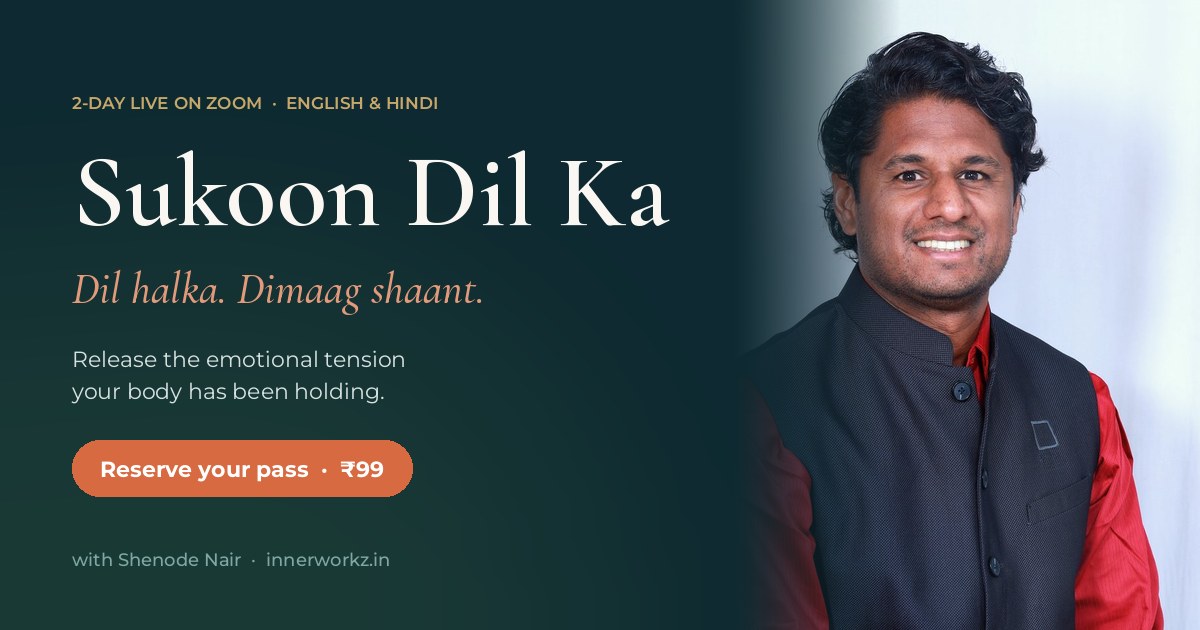
Experience it, don't just read about it: Sukoon is two live evenings on Zoom where you are guided to feel, release and settle, so regulation becomes something your body knows, not just something your mind understands.
You recover faster after an argument, a bad meeting or a hard day.
You can disagree without it becoming a fight, or a silence that lasts days.
You sleep better, because your body isn't carrying yesterday into tonight.
You make cleaner decisions, with fewer 11 pm regrets.
You feel more like yourself, even under pressure.
Common questions
Is emotional regulation the same as suppressing emotions?
No. Suppression pushes feelings down and pretends they aren't there, which usually shows up later as tension, outbursts or exhaustion. Emotional regulation means noticing the feeling, letting it move through you, and choosing your response.
Can adults learn emotional regulation?
Yes. Emotional regulation is a skill, not a fixed trait. The brain and nervous system stay adaptable throughout life, so with regular practice and support, adults can become steadier and recover faster from strong emotions.
What causes poor emotional regulation?
Common contributors include growing up in a home where feelings weren't welcome, long-term stress or burnout, painful or overwhelming experiences, poor sleep, and never having been taught practical tools. It is rarely a character flaw.
How long does it take to improve emotional regulation?
Many people notice small changes within a few weeks of daily practice, such as pausing before reacting or recovering more quickly. Deeper change, especially where old experiences are involved, usually takes longer and is easier with guidance.
An invitation
Feel fully and stay steady, with Sukoon
Sukoon means calm, and these two live evenings are designed to help you feel emotions safely rather than fight them. You are guided through releasing what your body has been holding, so staying steady starts to feel natural.
Two live 90-minute evening sessions on Zoom
Guided emotional release done gently and safely
Simple practices you can use the next time emotions run high
Runs every month, for ₹99, with a free healing toolkit included
Shenode Nair is a breakthrough coach and hypnotherapist based in Pune. For more than a decade he has helped professionals, founders, parents and homemakers release emotional patterns that logic alone couldn't shift.
Before founding InnerWorkz he spent years in corporate IT, including at Dell, so he knows life in survival mode from the inside. He is a certified NLP Practitioner (ABNLP), EFT Level 3 Practitioner (AAMET) and Matrix Reimprinting practitioner, and works with clients in Pune and online across India.
This article is for general education and isn't a substitute for medical or psychological care. If strong emotions feel unmanageable, or you have thoughts of harming yourself, please speak to a doctor or qualified mental health professional. Shenode Nair is a certified coach and practitioner, not a counsellor, psychologist or medical doctor. Read our full disclaimer.